Research evaluation and innovation
Should a new idea already outperform the state of the art?
Current performance alone cannot determine a research direction's value. Requiring new ideas to win before supporting their development can prevent breakthroughs.

A new approach can begin by performing worse than an established one. Should that be enough to stop investigating it?
I do not think so. Research needs room for ideas whose value is still emerging.
Consider early aviation. Balloons had already been carrying people since 1783, roughly 120 years before the Wright brothers’ powered flights. Ballooning remained challenging, but people had been flying long before the aeroplane appeared. (Smithsonian National Air and Space Museum)
In 1900, the first Zeppelin stayed airborne for around eighteen minutes. Three years later, the Wright brothers’ first powered flight lasted twelve seconds. Comparing flight duration alone would hardly have made the aeroplane look like the obvious direction to pursue. Yet those twelve seconds opened another path. (Zeppelin Museum, US National Park Service)
Neural networks offer another example. They had early successes, but deep networks also faced serious training difficulties. Advances in methods, computing power, and available data helped them achieve much stronger results across several tasks. Their early limitations did not establish the limits of the whole approach. (LeCun, Bengio and Hinton, 2015)
This matters for how we evaluate research, including which projects we fund.
“An alternative solution performs better” is not, by itself, an acceptable justification for rejecting a research proposal.
That comparison tells us something about current performance. A funding decision also needs to consider what the proposed research could teach us, which limitations it could overcome, and what possibilities it could open.
An established method may benefit from decades of refinement. A new approach may have only a first implementation, limited tuning, and unresolved technical problems. Requiring it to win before funding its development can create a circular barrier: it needs research to become competitive, but it cannot receive support because it is not yet competitive.
Both fundamental and applied research need room to explore beyond what already works best.
If beating the state of the art becomes a requirement for every contribution, we favour work close to what already succeeds. Incremental improvements become easier to justify, while approaches that need several intermediate steps struggle to survive.
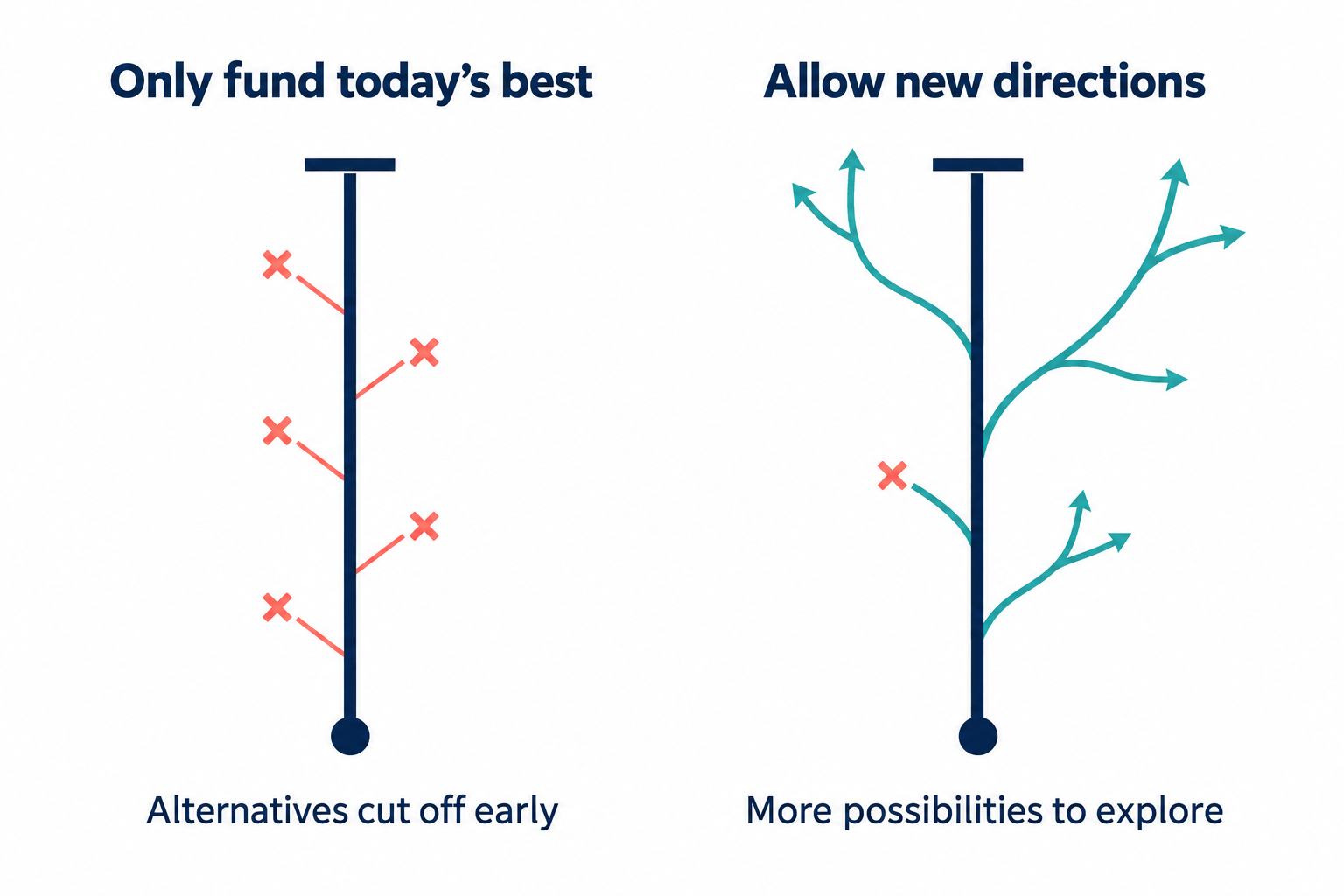
I imagine a tree where we cut off every new branch because it is smaller than the main one.
The main branch continues to grow, and for a while the strategy looks effective. But if it reaches an obstacle or breaks, we have removed the alternatives that could have grown in other directions.
Research needs those smaller branches. Some will lead nowhere. Others may become useful under conditions we have not yet explored. We cannot reliably distinguish all of them at their first appearance.
There is a similar intuition in biological diversity: judging everything by performance under today’s conditions risks losing variation that could matter when conditions change. “Best” always depends on the environment and on what we measure.
A new approach still needs a convincing motivation, careful evaluation, and an honest account of its limitations. Funding is limited, and potential deserves scrutiny. But that scrutiny must examine the research case itself. Pointing to a better-performing alternative does not settle it.
A method can contribute to research before it becomes the best tool for practical use.
If we want breakthroughs, we have to leave room for ideas to develop before they win.