<?xml version="1.0" encoding="utf-8"?>
<feed xmlns="http://www.w3.org/2005/Atom" xml:lang="en">
  <generator uri="https://jekyllrb.com/" version="4.4.1">Jekyll</generator>
  <link href="https://www.mgravey.com/viewpoints/feed.xml" rel="self" type="application/atom+xml" />
  <link href="https://www.mgravey.com/viewpoints/" rel="alternate" type="text/html" hreflang="en" />
  <updated>2026-10-26T14:25:37+01:00</updated>
  <id>https://www.mgravey.com/viewpoints/feed.xml</id>
  <title type="html">Viewpoints</title>
  <subtitle>Short, citable viewpoint papers on geoscience, data science, and research practice.</subtitle>
  <author>
    <name>Mathieu Gravey</name>
    <uri>https://www.mgravey.com/</uri>
  </author>
  <rights>CC BY-SA 4.0 (https://creativecommons.org/licenses/by-sa/4.0/)</rights>
  <entry>
    <title type="html">Why should we NOT get used to it?</title>
    <link href="https://www.mgravey.com/viewpoints/why-should-we-not-get-used-to-it/" rel="alternate" type="text/html" title="Why should we NOT get used to it?" />
    <published>2026-10-09T00:00:00+02:00</published>
    <updated>2026-10-09T00:00:00+02:00</updated>
    <id>https://www.mgravey.com/viewpoints/why-should-we-not-get-used-to-it/</id>
    <content type="html" xml:base="https://www.mgravey.com/viewpoints/why-should-we-not-get-used-to-it/"><![CDATA[<figure class="topic-figure">
  <a href="/viewpoints/assets/images/viewpoints/clearing-the-path.webp" aria-label="Open full-size image: Walkers follow a long detour around a fallen branch while one person lifts it out of the direct path.">
    <img src="/viewpoints/assets/images/viewpoints/clearing-the-path.webp" alt="Walkers follow a long detour around a fallen branch while one person lifts it out of the direct path." width="1536" height="1024" loading="eager" decoding="async" />
  </a>
  <figcaption>We can keep following the workaround, or remove the problem that made it necessary. <span class="figure-enlarge">Select image to enlarge.</span></figcaption>
</figure>

<p>In French, we have a familiar expression: <em>« On fait avec. »</em> We make do. We accept the situation and find a way to live with it.</p>

<p>Sometimes, we have to. But we too easily turn this temporary necessity into a permanent expectation.</p>

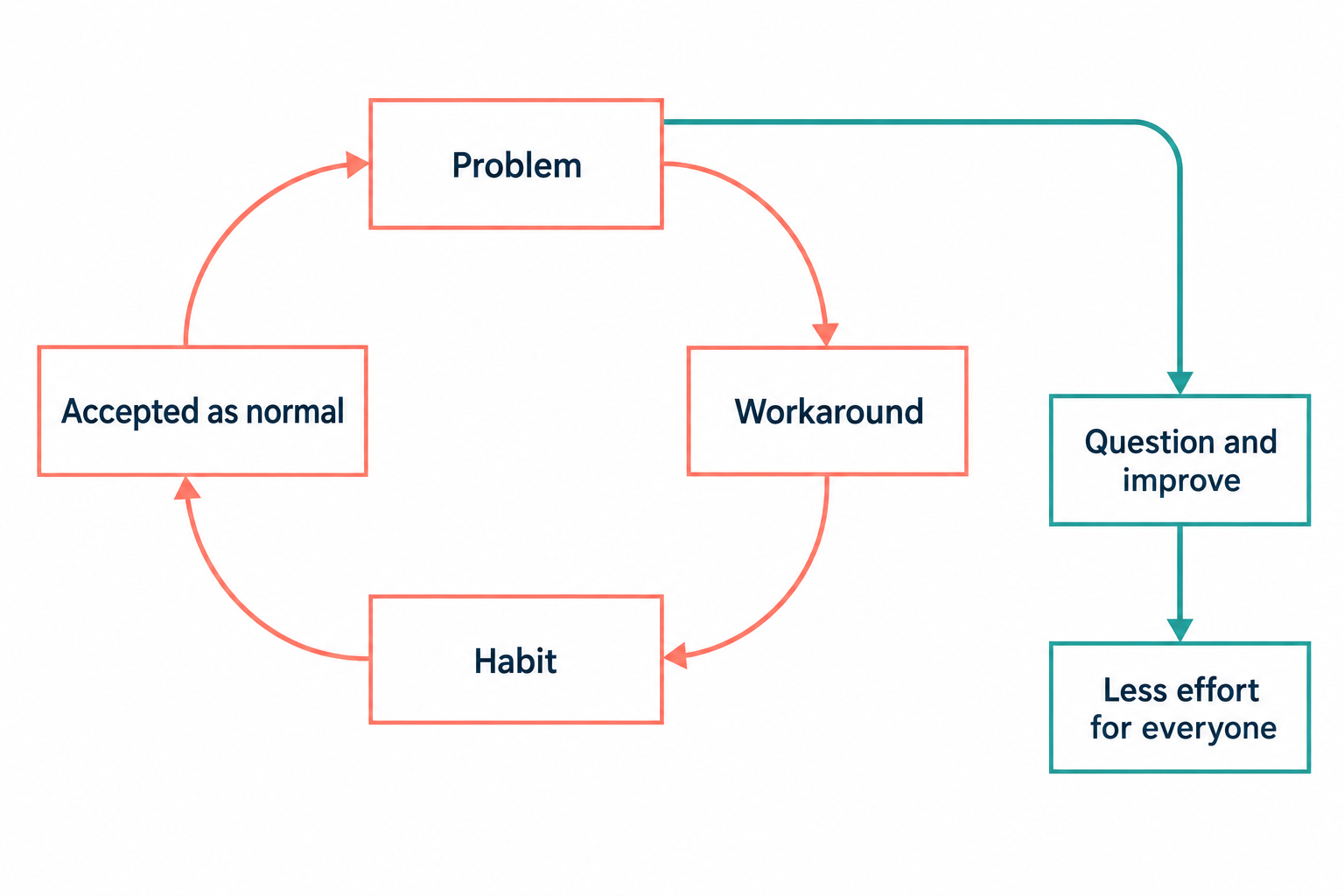
<p>A system does not work properly. We point out the problem. Changing it meets resistance, so eventually we stop asking and adapt. The problem remains, consuming a little more time and energy every time someone encounters it.</p>

<p>For whoever can change the system, resisting may be the cheapest option. Fixing something requires work; letting other people work around it requires much less. The cost has simply been transferred to everyone who has to use it.</p>

<p>And when we give up, we risk sending a convenient signal: apparently, fixing it was unnecessary. People adapted.</p>

<p>Our ability to cope becomes an excuse to leave the problem unresolved.</p>

<figure class="topic-figure">
  <a href="/viewpoints/assets/images/viewpoints/cycle-of-acceptance.webp" aria-label="Open full-size image: A cycle runs from problem to workaround to habit to accepted as normal, then back to the unresolved problem. An alternative path leads from the problem to question and improve, then to less effort for everyone.">
    <img src="/viewpoints/assets/images/viewpoints/cycle-of-acceptance.webp" alt="A cycle runs from problem to workaround to habit to accepted as normal, then back to the unresolved problem. An alternative path leads from the problem to question and improve, then to less effort for everyone." width="1536" height="1024" loading="lazy" decoding="async" />
  </a>
  <figcaption>A workaround can become a habit that keeps the original problem in place. Questioning it opens another path. <span class="figure-enlarge">Select image to enlarge.</span></figcaption>
</figure>

<p>I think we should keep expecting things to improve. We should question unnecessary friction, challenge choices that no longer make sense, and be willing to improve systems—or replace them when necessary.</p>

<p>This applies to research too.</p>

<p>When we get used to a method, an approximation, or even a mistake, we can gradually forget the reasoning behind it. A choice becomes a habit, and the habit becomes something nobody is expected to question.</p>

<p>Take principal component analysis, or PCA. People often keep the “most important” components. Here, <em>important</em> usually means <em>explaining the most variance</em>.</p>

<p>But why is variance what we care about?</p>

<p>Imagine that the quantity you want to predict depends entirely on the component with the least variance. You begin by removing that component because it explains so little of the total variance. You have just discarded the information you need to make the prediction. Preserving most of the variance does not necessarily preserve what matters for your question.</p>

<p>We should be able to explain why a criterion fits our objective. “This is the usual preprocessing step” is not enough.</p>

<p>Consider p-values as another example. Their interpretation depends on a specified null hypothesis and the assumptions of a statistical model. A p-value alone cannot establish scientific importance or replace reasoning about the question being studied. These problems are discussed in the <a href="https://doi.org/10.1080/00031305.2016.1154108">ASA statement on p-values</a>, <a href="https://doi.org/10.1007/s10654-016-0149-3"><em>Statistical tests, P values, confidence intervals, and power: a guide to misinterpretations</em></a>, and one of my favourites, <a href="https://doi.org/10.1053/j.seminhematol.2008.04.003"><em>A Dirty Dozen: Twelve P-Value Misconceptions</em></a>.</p>

<p>What worries me is the moment when we include an analysis because we expect a reviewer to demand it, even when we cannot justify its relevance. We might explain why it does not answer the scientific question—and still add it to get the paper accepted.</p>

<p>The consequences extend beyond that paper. Once published, it can become the reference a reviewer cites to demand the same analysis from someone else. A concession made to satisfy a reviewer becomes a justification for future requirements. Repetition gives the practice an appearance of legitimacy, even though its scientific justification was never established.</p>

<p>Eventually, satisfying the expectation becomes a reflex, and the original question disappears: <em>why are we doing this?</em></p>

<p>We cannot each fight every problem every day. But we can keep recognising a workaround as a workaround, and an unresolved problem as an unresolved problem.</p>

<p>Getting used to something does not make it reasonable. We should keep asking why, and keep expecting better.</p>]]></content>
    <author>
      <name>Mathieu Gravey</name>
    </author>
    <category term="Habits, systems, and scientific reasoning" />
    <category term="research-practice" />
    <category term="scientific-reasoning" />
    <category term="statistics" />
    <category term="systems" />
    <summary type="html"><![CDATA[Adapting to a problem can make it easier to leave unresolved. We should keep questioning habits, examining their costs, and expecting improvement.]]></summary>
    <media:thumbnail xmlns:media="http://search.yahoo.com/mrss/" url="https://www.mgravey.com/viewpoints/assets/images/viewpoints/clearing-the-path.webp" />
  </entry>
  <entry>
    <title type="html">Should a new idea already outperform the state of the art?</title>
    <link href="https://www.mgravey.com/viewpoints/should-a-new-idea-already-outperform-the-state-of-the-art/" rel="alternate" type="text/html" title="Should a new idea already outperform the state of the art?" />
    <published>2026-10-09T00:00:00+02:00</published>
    <updated>2026-10-09T00:00:00+02:00</updated>
    <id>https://www.mgravey.com/viewpoints/should-a-new-idea-already-outperform-the-state-of-the-art/</id>
    <content type="html" xml:base="https://www.mgravey.com/viewpoints/should-a-new-idea-already-outperform-the-state-of-the-art/"><![CDATA[<figure class="topic-figure">
  <a href="/viewpoints/assets/images/viewpoints/pruning-new-directions.webp" aria-label="Open full-size image: A gardener cuts young side shoots from a carefully supported tree whose main stem has reached a stone barrier overhead.">
    <img src="/viewpoints/assets/images/viewpoints/pruning-new-directions.webp" alt="A gardener cuts young side shoots from a carefully supported tree whose main stem has reached a stone barrier overhead." width="1536" height="1024" loading="eager" decoding="async" />
  </a>
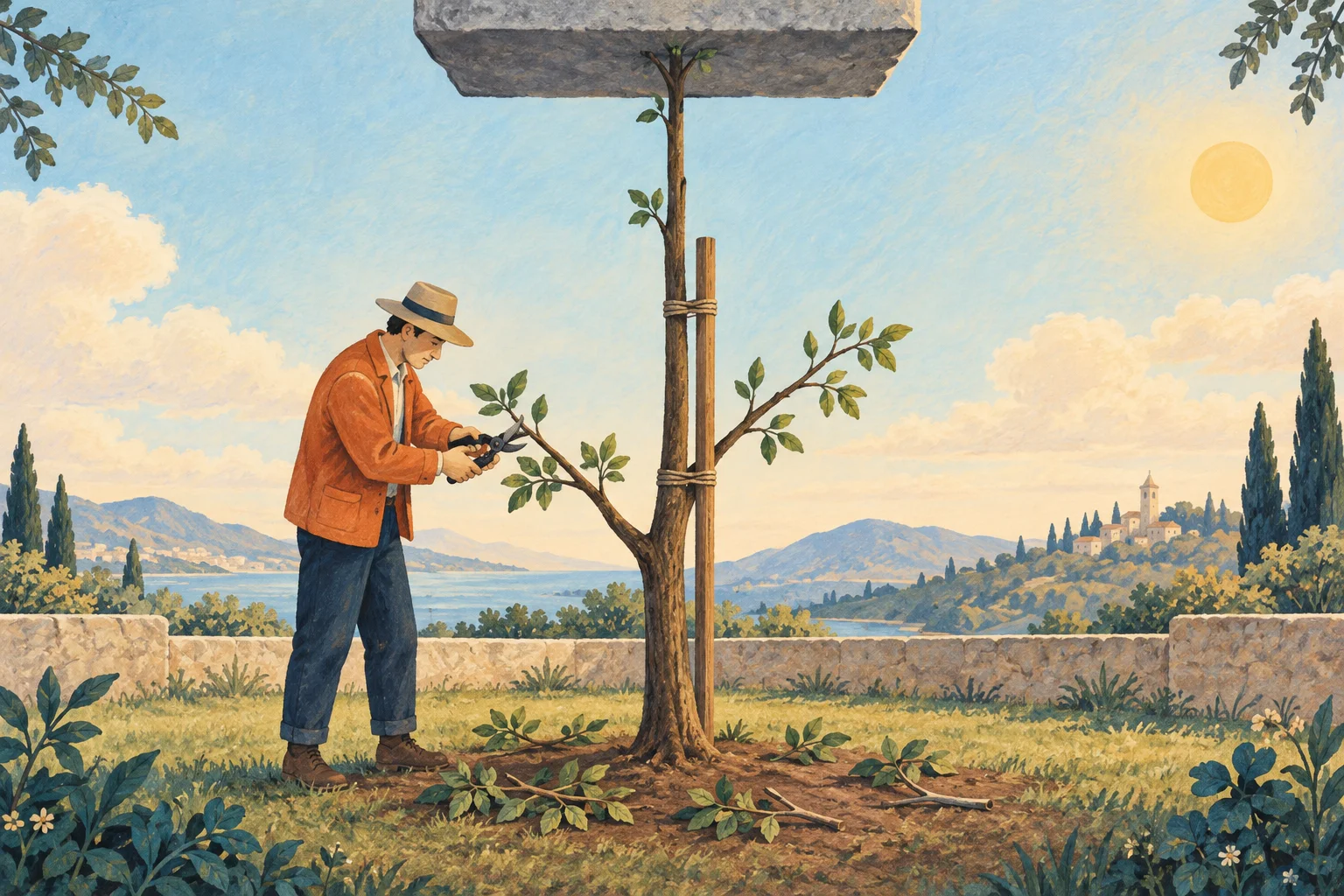
  <figcaption>Cutting every small branch leaves fewer directions to explore when the established path reaches a limit. <span class="figure-enlarge">Select image to enlarge.</span></figcaption>
</figure>

<p>A new approach can begin by performing worse than an established one. Should that be enough to stop investigating it?</p>

<p>I do not think so. Research needs room for ideas whose value is still emerging.</p>

<p>Consider early aviation. Balloons had already been carrying people since 1783, roughly 120 years before the Wright brothers’ powered flights. Ballooning remained challenging, but people had been flying long before the aeroplane appeared. (<a href="https://airandspace.si.edu/stories/editorial/presidential-writings-reveal-early-interest-ballooning">Smithsonian National Air and Space Museum</a>)</p>

<p>In 1900, the first Zeppelin stayed airborne for around eighteen minutes. Three years later, the Wright brothers’ first powered flight lasted twelve seconds. Comparing flight duration alone would hardly have made the aeroplane look like the obvious direction to pursue. Yet those twelve seconds opened another path. (<a href="https://www.zeppelin-museum.de/digitale-angebote/eine-vision-wird-wirklichkeit">Zeppelin Museum</a>, <a href="https://www.nps.gov/places/12-12-seconds-that-changed-the-world.htm">US National Park Service</a>)</p>

<p>Neural networks offer another example. They had early successes, but deep networks also faced serious training difficulties. Advances in methods, computing power, and available data helped them achieve much stronger results across several tasks. Their early limitations did not establish the limits of the whole approach. (<a href="https://doi.org/10.1038/nature14539">LeCun, Bengio and Hinton, 2015</a>)</p>

<p>This matters for how we evaluate research, including which projects we fund.</p>

<p><strong>“An alternative solution performs better” is not, by itself, an acceptable justification for rejecting a research proposal.</strong></p>

<p>That comparison tells us something about current performance. A funding decision also needs to consider what the proposed research could teach us, which limitations it could overcome, and what possibilities it could open.</p>

<p>An established method may benefit from decades of refinement. A new approach may have only a first implementation, limited tuning, and unresolved technical problems. Requiring it to win before funding its development can create a circular barrier: it needs research to become competitive, but it cannot receive support because it is not yet competitive.</p>

<p>Both fundamental and applied research need room to explore beyond what already works best.</p>

<p>If beating the state of the art becomes a requirement for every contribution, we favour work close to what already succeeds. Incremental improvements become easier to justify, while approaches that need several intermediate steps struggle to survive.</p>

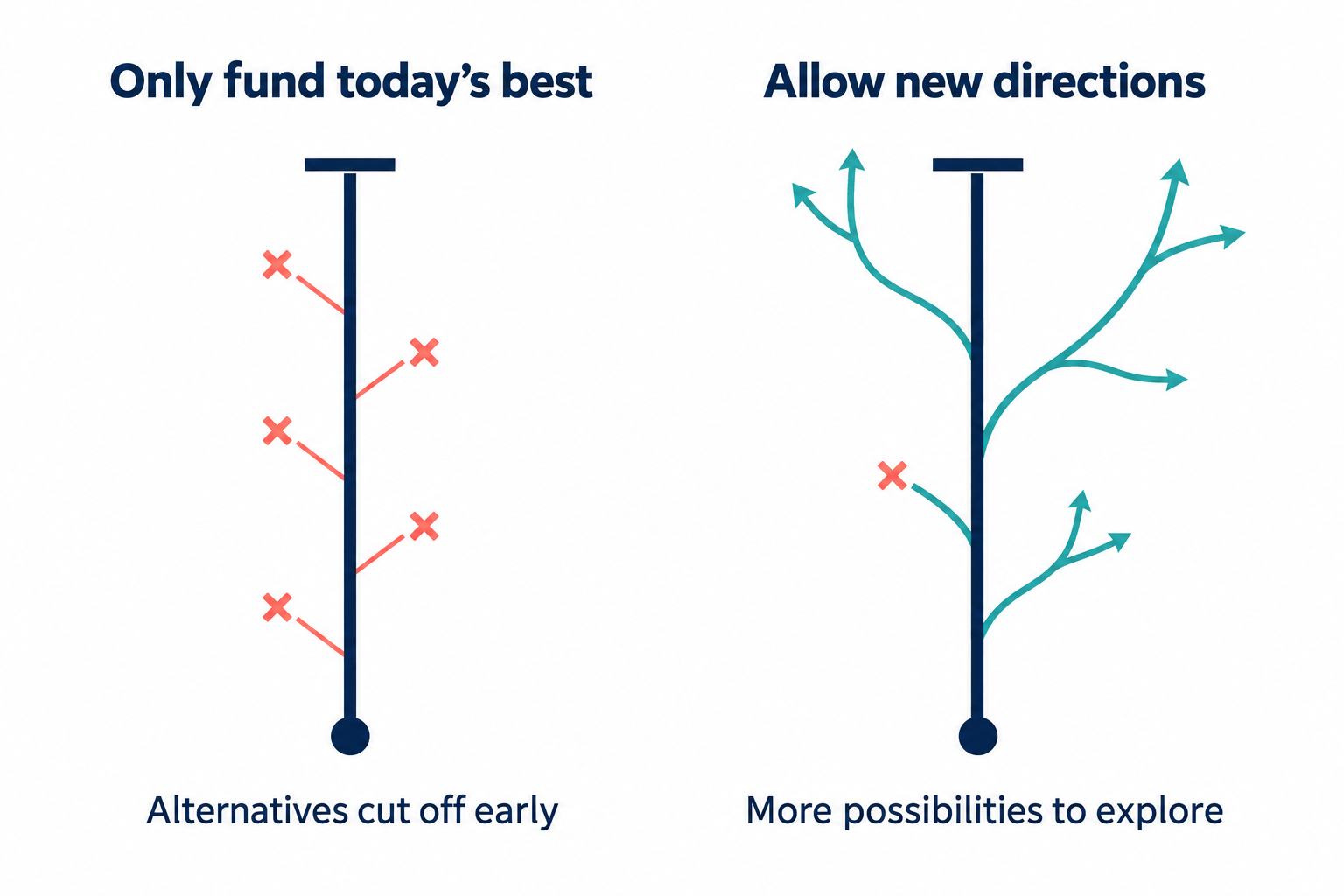
<p>I imagine a tree where we cut off every new branch because it is smaller than the main one.</p>

<p>The main branch continues to grow, and for a while the strategy looks effective. But if it reaches an obstacle or breaks, we have removed the alternatives that could have grown in other directions.</p>

<p>Research needs those smaller branches. Some will lead nowhere. Others may become useful under conditions we have not yet explored. We cannot reliably distinguish all of them at their first appearance.</p>

<figure class="topic-figure">
  <a href="/viewpoints/assets/images/viewpoints/research-alternatives.webp" aria-label="Open full-size image: Two research paths reach the same barrier. On the left, funding only today&#39;s best cuts off every alternative early. On the right, allowing new directions leaves several branches open to exploration, while one still ends unsuccessfully.">
    <img src="/viewpoints/assets/images/viewpoints/research-alternatives.webp" alt="Two research paths reach the same barrier. On the left, funding only today&#39;s best cuts off every alternative early. On the right, allowing new directions leaves several branches open to exploration, while one still ends unsuccessfully." width="1536" height="1024" loading="lazy" decoding="async" />
  </a>
  <figcaption>Supporting alternatives preserves possibilities. It does not guarantee that every new direction will succeed. <span class="figure-enlarge">Select image to enlarge.</span></figcaption>
</figure>

<p>There is a similar intuition in biological diversity: judging everything by performance under today’s conditions risks losing variation that could matter when conditions change. “Best” always depends on the environment and on what we measure.</p>

<p>A new approach still needs a convincing motivation, careful evaluation, and an honest account of its limitations. Funding is limited, and potential deserves scrutiny. But that scrutiny must examine the research case itself. Pointing to a better-performing alternative does not settle it.</p>

<p>A method can contribute to research before it becomes the best tool for practical use.</p>

<p>If we want breakthroughs, we have to leave room for ideas to develop before they win.</p>]]></content>
    <author>
      <name>Mathieu Gravey</name>
    </author>
    <category term="Research evaluation and innovation" />
    <category term="research-funding" />
    <category term="innovation" />
    <category term="research-evaluation" />
    <summary type="html"><![CDATA[Current performance alone cannot determine a research direction's value. Requiring new ideas to win before supporting their development can prevent breakthroughs.]]></summary>
    <media:thumbnail xmlns:media="http://search.yahoo.com/mrss/" url="https://www.mgravey.com/viewpoints/assets/images/viewpoints/pruning-new-directions.webp" />
  </entry>
  <entry>
    <title type="html">Should Peer Reviews Be More Intensive for High-Impact Journals?</title>
    <link href="https://www.mgravey.com/viewpoints/peer-review-effort-high-impact-journals/" rel="alternate" type="text/html" title="Should Peer Reviews Be More Intensive for High-Impact Journals?" />
    <published>2026-03-13T00:00:00+01:00</published>
    <updated>2026-03-13T00:00:00+01:00</updated>
    <id>https://www.mgravey.com/viewpoints/peer-review-effort-high-impact-journals/</id>
    <content type="html" xml:base="https://www.mgravey.com/viewpoints/peer-review-effort-high-impact-journals/"><![CDATA[<h2 id="the-question">The question</h2>

<p>When reviewing a manuscript, should we invest more effort if the submission is for a high-impact journal such as <em>Nature</em> or <em>Science</em>?
Or should review effort be independent of journal rank?</p>

<p>I do not aim to close this debate here.
The point is to expose two coherent positions.</p>

<h2 id="position-1-science-is-right-or-wrong-independently-of-journal-rank">Position 1: science is right or wrong, independently of journal rank</h2>

<p>In this view, review quality should not depend on prestige.
If a claim is correct, it is correct.
If it is wrong, it is wrong.
The venue does not change the truth value.</p>

<p>From this perspective, reviewers should apply comparable rigor everywhere:</p>

<ul>
  <li>check methods with the same seriousness,</li>
  <li>check assumptions and limitations with the same standard,</li>
  <li>and require the same level of clarity and reproducibility.</li>
</ul>

<p>The core argument is ethical and epistemic: science should be evaluated on content, not branding.</p>

<h2 id="position-2-errors-in-high-impact-venues-have-larger-downstream-consequences">Position 2: errors in high-impact venues have larger downstream consequences</h2>

<p>The opposite view starts from propagation.
Papers in high-impact journals are usually read more, cited more, and amplified faster.
If such a paper contains a flaw, that flaw can influence more projects, more funding directions, and more public narratives.</p>

<p>From this perspective, it is rational to allocate more review energy where potential impact of error is highest.
Not because the science is “different,” but because the cost of being wrong is larger.</p>

<p>In that logic, a stricter review for high-impact journals is a risk-management strategy.</p>

<h2 id="where-the-tension-sits">Where the tension sits</h2>

<p>The first position defends equality of scientific standards.
The second position defends asymmetry of consequences.
Both are internally consistent.</p>

<p>So the debate is not only about methodology.
It is also about fairness, responsibility, and how we distribute limited reviewer time.</p>

<h2 id="no-conclusion">No conclusion</h2>

<p>I do not provide a final answer here.
The goal is to make both philosophies explicit so each reviewer can think about where they stand, and why.</p>]]></content>
    <author>
      <name>Mathieu Gravey</name>
    </author>
    <category term="Peer review philosophy" />
    <category term="peer-review" />
    <category term="journals" />
    <category term="philosophy" />
    <summary type="html"><![CDATA[Two valid philosophies collide: same rigor everywhere vs extra rigor where flaws can propagate further.]]></summary>
  </entry>
  <entry>
    <title type="html">DEM of Difference vs. Differences of DEM</title>
    <link href="https://www.mgravey.com/viewpoints/dem-of-difference-vs-differences-of-dem/" rel="alternate" type="text/html" title="DEM of Difference vs. Differences of DEM" />
    <published>2026-03-13T00:00:00+01:00</published>
    <updated>2026-03-13T00:00:00+01:00</updated>
    <id>https://www.mgravey.com/viewpoints/dem-of-difference-vs-differences-of-dem/</id>
    <content type="html" xml:base="https://www.mgravey.com/viewpoints/dem-of-difference-vs-differences-of-dem/"><![CDATA[<h2 id="if-you-google-dod">If you google DoD</h2>

<p>you will likely land first on the US Department of Defense.
That is not the DoD we are discussing here.
Here, <strong>DoD</strong> is about DEMs and terrain change, not defense policy.</p>

<h2 id="start-with-the-equation-we-agree-on">Start with the equation we agree on</h2>

<p class="equation"><span class="math">DoD = DEM<sub>2</sub> - DEM<sub>1</sub></span></p>

<h2 id="why-elevation-of-difference-does-not-exist">Why “elevation of difference” does not exist</h2>

<p>Elevation is not just a number; it is a number <strong>relative to a reference surface</strong> (datum, geoid, ellipsoid, benchmark, etc.).
Without a reference, elevation is undefined.
So “elevation of difference” is a category error: a difference field is not itself an elevation quantity.</p>

<h2 id="why-dem-of-difference-is-awkward">Why “DEM of Difference” is awkward</h2>

<p>If DEM means <strong>Digital Elevation Model</strong>, then “DEM of Difference” reads like a model of “elevation of difference.”
But <span class="math">DoD</span> represents a difference between two elevations, not a new elevation.
Semantically, the phrase is inconsistent.</p>

<h2 id="names-that-make-sense">Names that make sense</h2>

<ul>
  <li><strong>Difference of elevation models</strong></li>
  <li><strong>Differences of DEMs</strong> (for multiple pairwise comparisons)</li>
  <li><strong>Elevation difference model</strong></li>
  <li><strong>Digital elevation difference model</strong></li>
  <li><strong>DEM difference map</strong> (plain-language option)</li>
</ul>

<h2 id="about-the-d-in-dem">About the “D” in DEM</h2>

<p>When was the last time we built a non-digital elevation model for this workflow?
Exactly.
In many contexts, “elevation model” is already sufficient; the digital nature is implied.</p>

<h2 id="conclusion">Conclusion</h2>

<p>If the goal is precise terminology, <strong>DEM of Difference</strong> should be retired.
Use <strong>difference of elevation models</strong> (or an explicit alternative) and define the equation once in the methods section.</p>]]></content>
    <author>
      <name>Mathieu Gravey</name>
    </author>
    <category term="Geomorphometry" />
    <category term="dem" />
    <category term="terminology" />
    <category term="methods" />
    <summary type="html"><![CDATA[Why 'DEM of Difference' is semantically shaky, and why 'differences of DEMs' is cleaner and more precise.]]></summary>
  </entry>
</feed>